

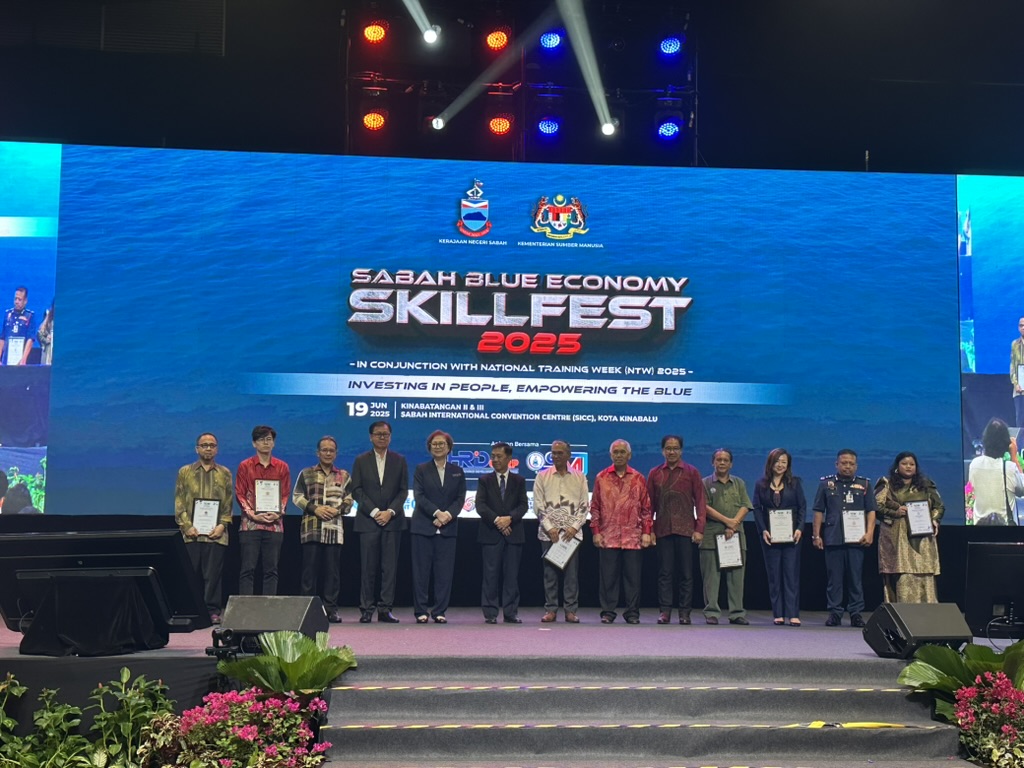
In alignment with its institutional commitment to the United Nations Sustainable Development Goals (SDGs), Jesselton University College (JUC) proudly participated as a collaborative partner in the Sabah Blue Economy SkillFest 2025, held on 19 June 2025 at the Sabah International Convention Centre (SICC) in Kota Kinabalu. The event was jointly organized by the Ministry of Human Resources Malaysia, HRD Corporation (HRDC), and the Sabah State Government, in conjunction with National Training Week (NTW).
SkillFest 2025 served as a significant cross sectoral platform that brought together public universities, private higher education institutions, government agencies, non governmental organizations, and industry stakeholders to discuss blue economy development, workforce empowerment, and sustainability strategies in Sabah. JUC’s active involvement reflected its role in advancing multi stakeholder dialogue that contributes to SDG 4 Quality Education, SDG 8 Decent Work and Economic Growth, SDG 13 Climate Action, and SDG 14 Life Below Water.
At the event, JUC collaborate its strategic initiatives in vocational education and training, community engagement, and digital transformation, particularly in coastal and marine related industries. JUC’s representatives also engaged in forum sessions, collaborative networking, and idea exchange focused on bridging skill gaps, promoting sustainability education, and preparing the future workforce for Sabah’s blue economy agenda.
The participation of high level policymakers, academic institutions, industry leaders, and civil society in this publicly accessible event positions it as a model of cross sectoral SDG dialogue in Malaysia. By contributing to such national level conversations, JUC reinforces its long term commitment to inclusive partnerships that drive meaningful progress toward the 2030 Agenda.
Beyond its participation in Sabah Blue Economy SkillFest 2025, Jesselton University College (JUC) engaged in additional cross-sectoral discussions addressing sustainable development challenges through partnerships with government institutions, non-governmental organisations and professional development stakeholders. These engagements provided opportunities to exchange perspectives, identify barriers affecting disadvantaged communities and consider collaborative approaches to improving educational access, vocational training and employment opportunities.
In February 2025, JUC collaborated with Sabah Cheshire Home and Services and the Sabah Ministry of Community Development and People’s Well-being in discussions concerning disability inclusion, vocational training and employment access. The engagement brought together representatives from higher education, government and the NGO sector to examine barriers affecting persons with disabilities and consider strategies for strengthening inclusive training opportunities, workplace readiness and employment pathways. The collaboration was complemented by the Effective Communication in Hospitality Programme and an MoU between JUC and Sabah Cheshire Home.
JUC also engaged with CACE and Sabah Skills Development Sdn. Bhd., represented by Chief Executive Officer Ts. Hazrullizam Idris, in discussions concerning SDG-related education strategies for the proposed 2027–2030 implementation period. The discussions addressed barriers to higher education, recognition of prior learning, professional qualifications and lifelong learning opportunities for working adults and disadvantaged learners. Through this engagement, participating organisations considered potential approaches to improving educational accessibility and strengthening cooperation between higher education and skills development stakeholders.
Together, these engagements demonstrate JUC’s participation in cross-sectoral dialogue concerning SDG-related challenges, particularly educational inequality, disability inclusion, skills development and employment access. By bringing together perspectives from higher education, government, NGOs and professional development organisations, JUC seeks to strengthen collaborative approaches to addressing sustainability challenges and advancing SDG 4, SDG 8, SDG 10 and SDG 17.