
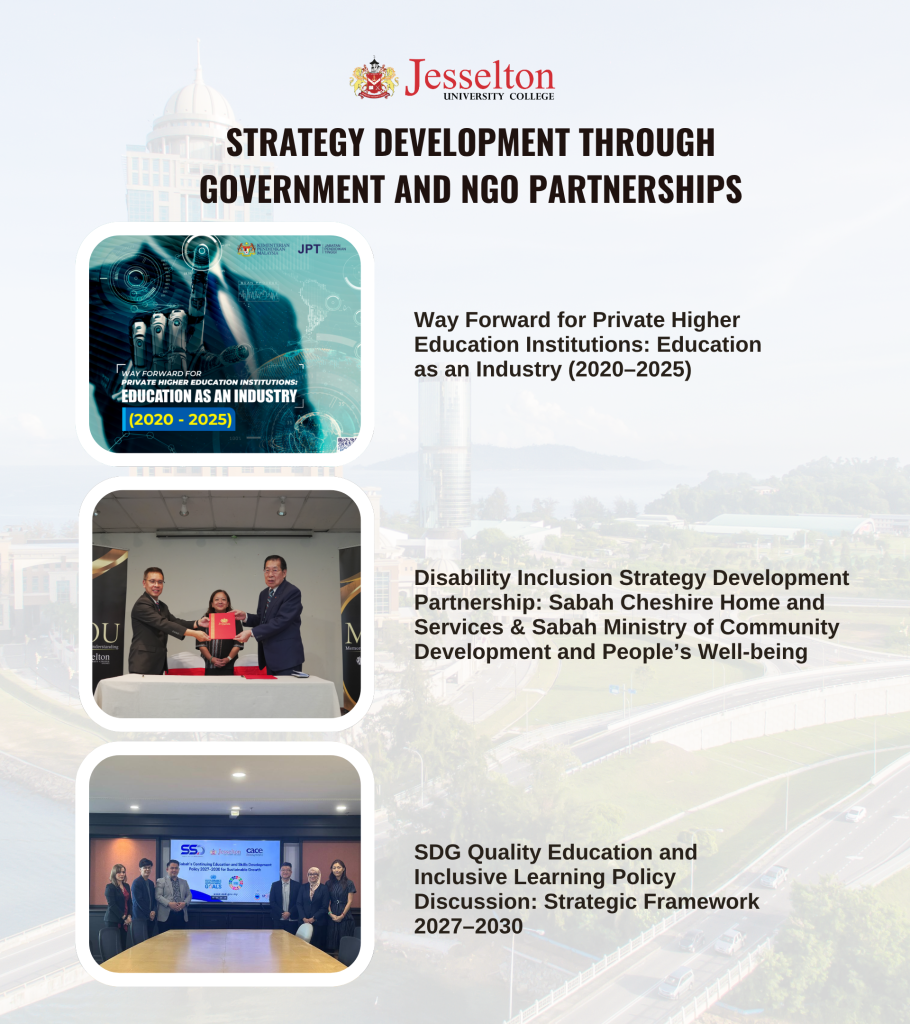
Jesselton University College (JUC) strengthens its contribution to the United Nations Sustainable Development Goals (SDGs) through direct involvement in policy-oriented discussions and strategy development with government institutions and regional non-governmental organisations (NGOs). In 2025, JUC contributed strategic recommendations to Sabah Cheshire Home and Services concerning disability inclusion, vocational training and employment access, through a collaboration involving the Sabah Ministry of Community Development and People’s Well-being. The University has also contributed policy recommendations and analysis concerning higher education accessibility through its involvement in a publication addressing the development of Malaysia’s private higher education sector.
JUC’s institutional approach to SDG policy engagement focuses on identifying social and educational challenges, sharing evidence and practical experience, and contributing recommendations to organisations responsible for developing policies and strategies. Drawing upon its experience in higher education, professional training and community engagement, the University provides perspectives on barriers affecting disadvantaged communities and opportunities for more inclusive education and workforce participation. These contributions support SDG 4 (Quality Education), SDG 8 (Decent Work and Economic Growth), SDG 10 (Reduced Inequalities) and SDG 17 (Partnerships for the Goals).
In February 2025, JUC collaborated with Sabah Cheshire Home and Services and the Sabah Ministry of Community Development and People’s Well-being on an initiative addressing vocational training and employment-related challenges faced by persons with disabilities. The collaboration included the Effective Communication in Hospitality training programme and the signing of a Memorandum of Understanding between JUC and Sabah Cheshire Home. The initiative provided an opportunity for participating organisations to examine barriers affecting access to vocational education, professional communication, workplace readiness and employment opportunities for persons with disabilities.
Beyond the delivery of vocational training, JUC contributed strategic input to Sabah Cheshire Home’s organisational approach to disability inclusion, vocational training and employment access. The University’s contribution drew upon its experience in education and workforce development to identify practical challenges affecting persons with disabilities and recommend approaches for improving access to skills development. These recommendations addressed inclusive training opportunities, employment preparation, communication skills and collaboration between educational institutions and disability support organisations.
JUC’s strategic contribution focused on three interconnected areas. First, disability inclusion was considered in relation to barriers that may limit participation in education, training and employment. Second, vocational training was examined as a means of strengthening practical skills and employment readiness among persons with disabilities. Third, employment access was considered through the development of training pathways and institutional partnerships intended to support individuals transitioning towards the workforce. These areas provided a basis for JUC’s recommendations to Sabah Cheshire Home concerning the continued development of its disability inclusion and vocational support strategies.
The involvement of the Sabah Ministry of Community Development and People’s Well-being provided an important connection between the NGO’s disability inclusion objectives and broader government priorities concerning community welfare and equal opportunities. Through the collaboration, JUC contributed educational and training perspectives relevant to the challenges identified by participating stakeholders. The University’s direct strategy-development contribution was made to Sabah Cheshire Home, while the ministry’s involvement strengthened cooperation between higher education, the NGO sector and government representatives in addressing disability-related development challenges.
At the national level, JUC contributed to policy-oriented discussions concerning Malaysia’s private higher education sector through the involvement of its President, Prof. Datuk Dr. Fred Y. F. Chin, in the publication Way Forward for Private Higher Education Institutions: Education as an Industry (2020–2025). The publication addresses challenges and strategic considerations affecting private higher education institutions, including institutional sustainability, educational accessibility and the sector’s contribution to national development. JUC’s contribution included policy recommendations and analysis concerning access to higher education.
Through its contribution, JUC examined challenges affecting educational accessibility and provided recommendations relevant to improving opportunities for students from diverse socioeconomic and educational backgrounds. The analysis considered the importance of reducing barriers to higher education and strengthening the contribution of private higher education institutions to inclusive educational development. These recommendations reflect JUC’s institutional experience in supporting students from disadvantaged backgrounds and its commitment to promoting equitable access to educational opportunities.
JUC also engaged with CACE and Sabah Skills Development Sdn. Bhd. (SSD), represented by its Chief Executive Officer, Ts. Hazrullizam Idris in discussions concerning the development of education-related policies and strategies for the proposed implementation period of 2027–2030. The discussions focused on advancing Sustainable Development Goal 4 (Quality Education) and Sustainable Development Goal 17 (Partnerships for the Goals), particularly through improving access to education, reducing barriers to lifelong learning and strengthening opportunities for individuals from disadvantaged socioeconomic and educational backgrounds.
The policy discussions examined challenges affecting educational accessibility, including financial constraints, limited access to professional qualifications, geographical barriers and difficulties experienced by working adults seeking to pursue further education. Particular attention was given to the importance of creating more inclusive educational pathways for individuals who may not meet conventional academic entry requirements but possess relevant professional knowledge, workplace experience or vocational competencies.
As part of these discussions, JUC contributed institutional perspectives and recommendations concerning flexible educational pathways, recognition of prior learning, professional certification and skills-based progression opportunities. The proposed policy directions considered how higher education institutions and professional development organisations could strengthen access to education through alternative entry pathways, lifelong learning initiatives and closer alignment between academic qualifications and industry requirements.
The discussions also considered a proposed 2027–2030 policy implementation framework focusing on educational accessibility, vocational and professional development, and opportunities for underserved communities. Areas identified for further consideration included reducing financial and academic entry barriers, strengthening cooperation between educational institutions and skills development organisations, and improving progression opportunities for working adults and individuals with non-traditional educational backgrounds.
JUC’s input contributed to policy-oriented discussion by connecting institutional experience with broader strategic questions concerning the development of Malaysia’s private higher education sector. The University’s recommendations addressed educational access and the role of private institutions in supporting national education objectives. This contribution illustrates how higher education institutions can provide analysis and recommendations relevant to government policy discussions, particularly in areas connected to SDG 4 (Quality Education) and SDG 10 (Reduced Inequalities).