
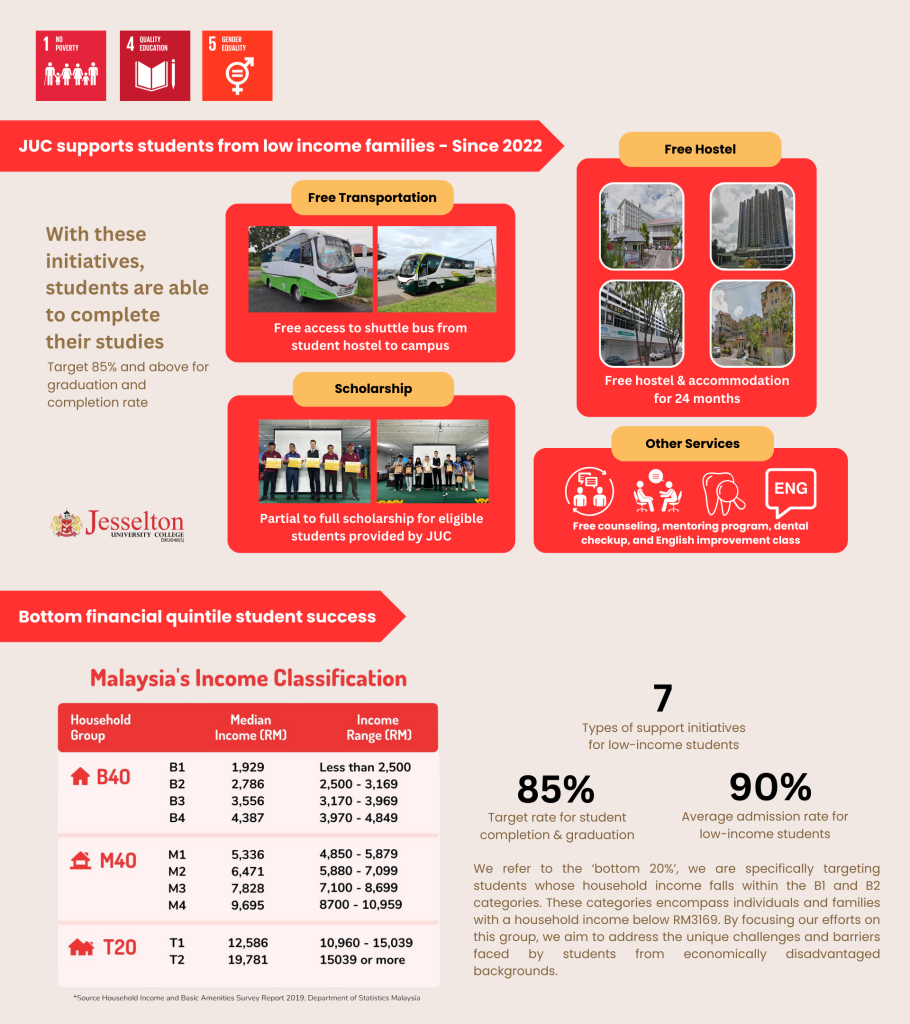
Jesselton University College (JUC) is deeply committed to ensuring that students from the lowest income households can access, pursue, and successfully complete their education. Since 2022, JUC has implemented a long-term institutional support programme specifically designed to assist students whose household income falls within the B1 and B2 categories of Malaysia’s income classification, commonly referred to as the bottom 20 percent income group (monthly household income below RM3,169).
To address the unique barriers faced by this group, JUC provides seven types of free support services, including:
- Free transportation via campus shuttle buses
- Free hostel accommodation for 24 months
- Partial to full scholarships for eligible students
- Free academic and non-academic support such as English improvement classes, mentoring, counselling, and dental checkups
These initiatives are fully funded by the institution and are not based on gender, race, or background, ensuring equal access and opportunity for all qualified students, particularly those from economically disadvantaged backgrounds.
These support services remained available to eligible low-income students throughout 2026. In particular, JUC’s free transportation and free hostel accommodation are designed to reduce essential living and commuting costs that may otherwise affect a student’s ability to remain enrolled and successfully complete their studies. The support forms part of JUC’s continuing institutional commitment to students from low-income families and is provided without charge to eligible beneficiaries.
To monitor and improve the effectiveness of this programme, JUC has set a formal institutional target of an 85 percent graduation and completion rate for low-income students from the bottom 20 percent household income group. This 85 percent graduation/completion target remained active throughout 2026 as a measurable institutional benchmark for monitoring the retention, progression, and successful completion of eligible low-income students. Progress towards the target is reviewed through JUC’s institutional student records, enabling the university to monitor whether its financial, academic, and welfare support mechanisms are effectively helping low-income students successfully complete their higher education.
These metrics reflect JUC’s ongoing efforts not only to increase access to higher education but also to actively support the academic success and long-term well-being of students from the bottom financial quintile. The 85 percent graduation/completion target reinforces JUC’s commitment to ensuring that financial disadvantage does not prevent eligible students from successfully completing their studies.
This comprehensive support programme reflects JUC’s strong institutional commitment to SDG 1 (No Poverty) and SDG 4 (Quality Education). By eliminating financial and structural barriers to higher education, JUC actively promotes social equity and uplifts students from disadvantaged backgrounds through inclusive, high-impact educational opportunities.