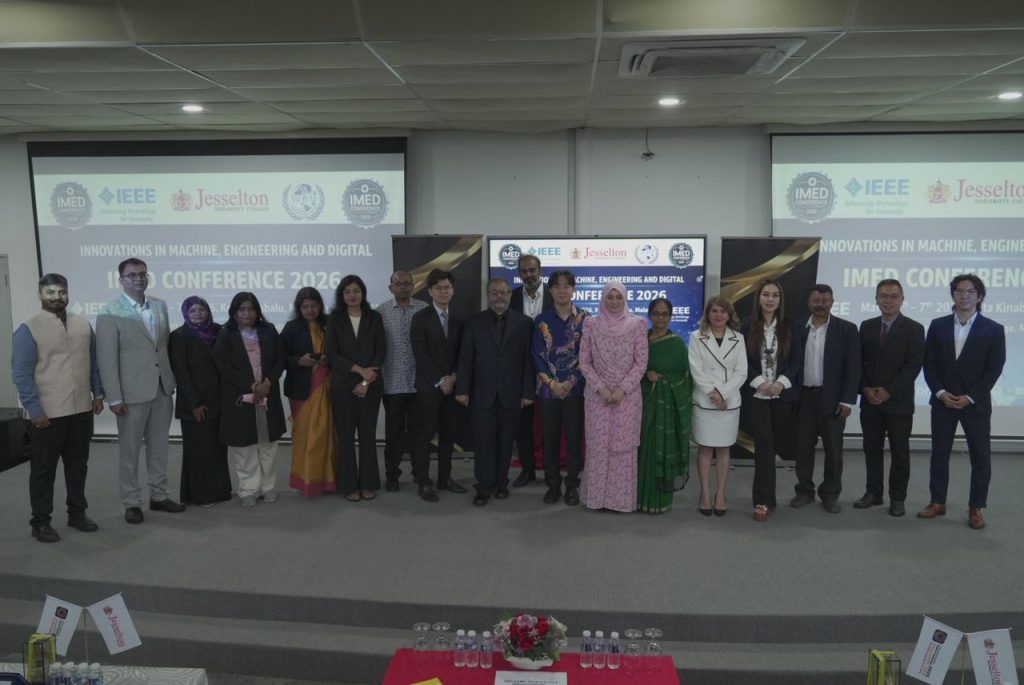
Kota Kinabalu, Sabah 6 March 2026 – Jesselton University College (JUC), in collaboration with the World Research Union (WRU), successfully co-organised the Innovations in Machine, Engineering and Digital Conference 2026 (IMED-2026). The international research conference brought together academics, researchers and industry experts from Asia, Europe and the Middle East to exchange research findings, examine technological approaches and strengthen international cooperation in addressing challenges relevant to the United Nations Sustainable Development Goals (SDGs).
The conference provided an international platform for researchers to present developments in artificial intelligence, engineering innovation, digital transformation and emerging technologies. Through research presentations and academic discussions, participants had opportunities to examine different technological approaches, exchange knowledge and explore their potential applications to sustainable development. The conference encouraged international collaboration in research and the sharing of innovative practices across academic and industry sectors.
IMED-2026 received over 400 international research submissions, with 117 papers accepted following a peer-review process. The accepted papers covered machine technologies, engineering applications and digital innovation, providing opportunities for researchers from different countries to share methodologies, findings and technological solutions. Selected research papers were designated for publication in the IEEE Xplore Digital Library, which is indexed by Scopus, supporting wider international dissemination of research findings.
The research papers presented at IMED-2026 may contribute to several United Nations Sustainable Development Goals, particularly SDG 4 (Quality Education), SDG 8 (Decent Work and Economic Growth), SDG 9 (Industry, Innovation and Infrastructure) and SDG 17 (Partnerships for the Goals). Through international research collaboration, knowledge exchange and the sharing of technological approaches, these studies may support the identification of innovative solutions and best practices for addressing sustainable development challenges.
The conference featured keynote presentations by Professor Dr. Datuk Massila Kamalrudin, Vice Chancellor of Universiti Teknikal Malaysia Melaka, and Dr. Shilpa Bade-Gite, Director of the Dr. D. Y. Patil School of Science and Technology, India. Their participation strengthened international academic engagement and provided perspectives on engineering research, artificial intelligence and technological innovation. The conference’s hybrid format further enabled international researchers to participate in academic discussions and exchange findings across geographical boundaries.
An important component of IMED-2026 was its emphasis on international research collaboration and knowledge exchange. Through research presentations and discussions, participants had opportunities to review different research methodologies, consider alternative technological approaches and identify practices that could be applicable across different countries and industries. Such international exchanges may contribute to the development of research-informed approaches and potential best practices for addressing challenges related to innovation, education and sustainable economic development.
As part of the conference, JUC also formalised international academic collaborations through Memoranda of Understanding (MoUs) with three institutions from India: Global Academy of Technology, St. Francis De Sales College (Autonomous) and Dr. D. Y. Patil School of Science and Technology, Pune. These partnerships aim to strengthen international cooperation in research, academic exchange and education initiatives, creating opportunities for continued comparative research, knowledge sharing and the development of innovative practices relevant to sustainable development.
Through IMED-2026, Jesselton University College strengthened its role in facilitating international research collaboration, comparative knowledge exchange and academic partnerships. By bringing together researchers from different countries and encouraging the examination of technological approaches, the University supported opportunities to identify and share potential international best practices for addressing sustainability challenges. The initiative reflects JUC’s commitment to advancing SDGs 4, 8, 9 and 17 through international research engagement, innovation and academic cooperation.