
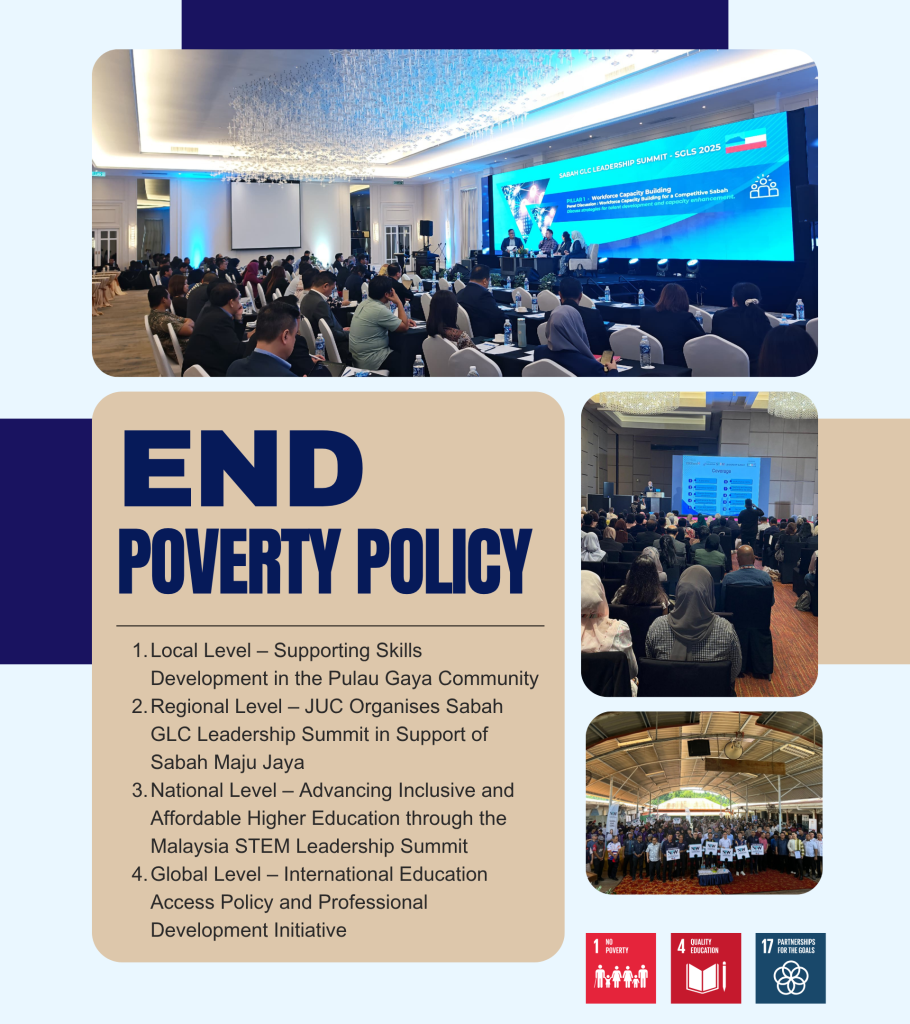
Jesselton University College (JUC) continues to strengthen its contribution to inclusive socioeconomic development through programmes and policy-related initiatives at local, regional, national and global levels.
Through collaboration with government agencies, Government-Linked Companies (GLCs), policymakers, education leaders, international organisations and community stakeholders, JUC contributes its expertise in education, training and human-capital development to initiatives that strengthen skills development, access to education, employability, workforce participation and economic mobility.
These initiatives reflect JUC’s commitment to addressing poverty in its different dimensions by creating opportunities for individuals and communities to develop relevant skills, continue their education, improve employment prospects and strengthen their capacity for socioeconomic advancement.
Local Level – Supporting Skills Development in the Pulau Gaya Community
At the local level, JUC participated in a community human-capital development initiative at Pulau Gaya, Sabah, in conjunction with National Training Week (NTW), together with the Ministry of Human Resources (KESUMA), HRD Corp and other stakeholders.
The initiative focused on expanding access to skills development and economic opportunities for communities in Pulau Gaya. More than 450 residents from four Pulau Gaya villages participated in skills-development activities covering areas including floral entrepreneurship, digital marketing and dropshipping.
As a collaborating higher-education institution, JUC supported the initiative through the sponsorship and provision of free training opportunities for members of the local community. This enabled JUC to contribute its education and training capacity to practical skills development that can support employment, self-employment, entrepreneurship and income-generating opportunities.
Through its participation, JUC contributed to the local implementation of a government-supported community development initiative that strengthens skills development, entrepreneurship and employability. By equipping community members with practical and employment-related skills, the initiative supports improved livelihood opportunities and helps reduce socioeconomic vulnerability.
Regional Level – JUC Organises Sabah GLC Leadership Summit in Support of Sabah Maju Jaya
At the regional level, JUC organised the Sabah GLC Leadership Summit (SGLS) as a Sabah-level platform supporting human-capital, workforce and socioeconomic development. JUC also served as the training provider for the summit, reflecting the university’s institutional role in delivering the initiative.
The summit was designed to accelerate the development of a future-ready, resilient and high-performing workforce in alignment with the Sabah Maju Jaya (SMJ) strategic blueprint. It also focused on strengthening leadership capabilities, strategic thinking and effective governance among Sabah GLC leaders.
As organiser, JUC facilitated discussions and knowledge exchange on workforce development, leadership, employee well-being, future technology and human-capital development. These areas are important to strengthening the capabilities of organisations and their workforce to respond to changing economic, employment and industry needs.
By aligning the summit with the Sabah Maju Jaya strategic blueprint, JUC contributed to regional-level implementation and policy dialogue concerning Sabah’s human-capital and workforce-development priorities. Stronger workforce capabilities can contribute to productivity, employability, employment opportunities and economic mobility, supporting broader efforts to reduce socioeconomic vulnerability across the state.
National Level – Advancing Inclusive and Affordable Higher Education through the Malaysia STEM Leadership Summit
At the national level, JUC participated in the Malaysia STEM Leadership Summit, a national platform bringing together policymakers, education leaders, academics and industry stakeholders to discuss the future development of education in Malaysia.
JUC was represented by its Vice Chancellor, Prof. Dr. Mohamad Afzhan Khan, who contributed to the national education dialogue through his presentation, “Promoting Quality and Inclusivity in Open and Distance Learning for Mathematics Education.” His contribution highlighted affordable Open and Distance Learning (ODL) and flexible learning pathways, including Accreditation of Prior Experiential Learning (APEL), as approaches to widening participation in higher education.
Flexible education pathways are particularly relevant to working adults, non-traditional learners and individuals who may face socioeconomic, geographical or conventional-entry barriers to higher education. ODL provides greater flexibility for individuals to continue employment while studying, while APEL recognises knowledge and competencies acquired through previous work and experiential learning.
Prof. Dr. Mohamad Afzhan Khan’s contribution in this area is also supported by his involvement as a co-author of the UNESCO International Institute for Educational Planning publication SDG-4: Flexible Learning Pathways in Higher Education – from Policy to Practice, which examines recognition of prior learning and flexible pathways, including their relevance to disadvantaged and marginalised learners. Through this national platform, JUC contributed institutional expertise to dialogue on inclusive and flexible higher education, supporting wider access to qualifications, skills development, employability and socioeconomic mobility.
Global Level – International Education Access Policy and Professional Development Initiative
At the global level, Jesselton University College (JUC), Malaysia, and the Chartered Association of Continuing Education (CACE), Canada, have jointly implemented an international education-access policy and professional-development initiative since 2025, supported by Sabah Skills Development Sdn. Bhd. (SSD).
The initiative expands opportunities for students and learners to continue their education, develop professional competencies and access continuing education and professional-development pathways. It combines JUC’s higher-education capacity with CACE’s expertise in continuing education, professional certification and competency development within an international collaborative framework.
Under the initiative, JUC provides the academic and student-development platform, while CACE contributes professional certification, competency development, continuing education and lifelong-learning opportunities. The collaboration provides additional pathways for students and learners to strengthen their knowledge, professional competencies and employment-related skills as part of their continuing academic and career development.
The collaboration is supported by SSD, a Human Capital Empowerment Government-Linked Company under Sabah’s Ministry of Education, Science, Technology and Innovation. SSD has recognised CACE’s certification and evaluation services as supporting skills development, competency enhancement and human-capital empowerment, and has expressed support for collaboration in workforce capability, professional development and lifelong learning. Through this international initiative, JUC contributes to expanding education and professional-development opportunities that can strengthen employability, career progression and economic mobility, particularly for learners who may face socioeconomic barriers to continued development.