
Jesselton University College (JUC) continues to strengthen its commitment to gender equality and inclusive education through institutional monitoring of female and male students’ academic progression and graduation outcomes. By tracking graduation data according to gender, JUC seeks to assess women’s likelihood of successfully completing their studies compared with men, identify potential disparities and implement appropriate support measures to address barriers affecting student retention and graduation. These efforts form part of the University’s ongoing commitment to ensuring that female and male students have equitable opportunities to complete their qualifications.
JUC’s approach combines gender-disaggregated graduation monitoring with academic mentoring, career guidance, leadership development and student welfare support. The University recognises that differences in academic progression and completion may be influenced by financial difficulties, educational disadvantages, personal responsibilities and access to academic support. Through its academic departments and student support services, JUC aims to identify students requiring additional assistance and provide appropriate interventions to strengthen academic performance, reduce the risk of study interruption and support successful graduation.
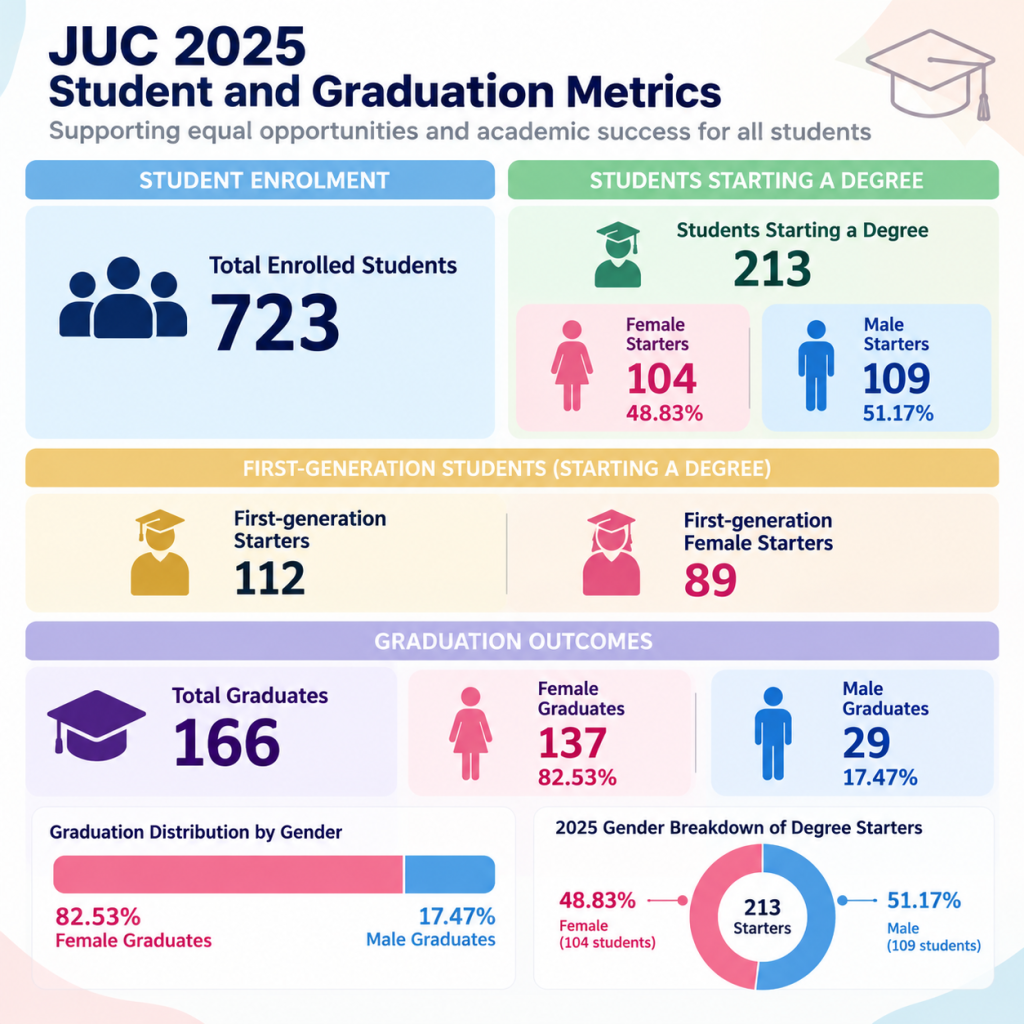
In 2025, JUC recorded 166 graduates, comprising 137 female graduates (82.53%) and 29 male graduates (17.47%). These figures provide an overview of the gender composition of graduates and contribute to the University’s monitoring of women’s participation and educational outcomes. JUC also recorded 213 students starting degree programmes during the year, including 104 women (48.83%) and 109 men (51.17%). By maintaining gender-disaggregated records of student entry and graduation, the University establishes a basis for examining differences in educational participation and completion over time.
A comparison of JUC’s graduation figures between 2024 and 2025 indicates an increase in the number of female graduates. In 2024, the University recorded 151 graduates, including 82 women and 69 men, with women representing 54.30% of graduates. In 2025, the number of female graduates increased to 137, representing a 67.07% increase in female graduate numbers, while women’s share of total graduates increased by 28.23 percentage points, from 54.30% to 82.53%. Total graduates also increased from 151 to 166, representing a 9.93% increase. These figures demonstrate changes in the gender distribution of graduates, although a complete assessment of women’s likelihood of graduating compared with men’s also requires tracking the completion rates of comparable student cohorts.
To strengthen institutional responses to potential gender disparities in academic progression and graduation, JUC established four long-term mentoring programmes in 2025: the Thrive Mentorship Programme, Career Development Mentoring Programme, Academic Mentoring Programme and Female Leadership Mentoring Programme. These programmes form part of the University’s ongoing student support framework and are designed to continue annually rather than operate as one-off activities. Together, they provide structured opportunities for academic guidance, career preparation, leadership development and personal support, particularly for female students from disadvantaged backgrounds and those pursuing fields where women may be underrepresented.
The Thrive Mentorship Programme, introduced under the theme “Let’s Help Each Other”, provides inclusive guidance and mentoring support to students, particularly women from underserved communities and those entering traditionally male-dominated fields. Through connections with lecturers, university staff and experienced mentors, students are encouraged to strengthen their confidence, develop academic and professional aspirations, and establish supportive networks. The programme seeks to address barriers that may affect women’s participation and progression by providing opportunities to seek guidance, exchange experiences and receive encouragement throughout their educational journey.
The Career Development Mentoring Programme supports students in preparing for employment and long-term professional advancement through career planning, professional guidance and employability development. Students receive mentoring on career pathways, workplace expectations, professional communication, résumé preparation, interview readiness and networking opportunities. By helping female students identify professional goals and develop confidence in pursuing employment opportunities, the programme aims to strengthen their motivation, career readiness and continued engagement with higher education. This support complements JUC’s wider efforts to encourage students to complete their qualifications and prepare for successful transitions into the workforce.
The Academic Mentoring Programme directly supports students’ academic progression and successful completion of their studies through guidance from lecturers and academic advisers. Mentoring activities focus on academic planning, study strategies, assignment preparation, examination readiness and academic performance improvement. Particular attention is given to students who may experience learning difficulties or additional educational challenges, including those from low-income households and disadvantaged backgrounds. Through accessible academic guidance and individual support, JUC seeks to identify academic difficulties, strengthen learning confidence and reduce barriers that could contribute to delayed completion or withdrawal from university programmes.
The Female Leadership Mentoring Programme focuses on strengthening women’s leadership capabilities, confidence and participation in university and community activities. Through mentoring relationships with lecturers, university staff and experienced female professionals, students are encouraged to develop communication, decision-making, teamwork and problem-solving skills. The programme also promotes opportunities for female students to participate in student organisations, academic initiatives and community engagement activities. By fostering confidence, supportive relationships and leadership participation, JUC aims to strengthen women’s engagement with university life and encourage their continued academic and professional development.
Beyond these four mentoring programmes, JUC provides additional institutional support measures intended to address barriers that may affect students’ academic progression and graduation. These include academic counselling, career guidance, scholarships, financial assistance and student welfare services, together with transportation and accommodation support for eligible students. Such provisions are particularly relevant to students from low-income families, rural communities and disadvantaged backgrounds who may face financial or personal difficulties while pursuing higher education. Through these support measures, JUC aims to reduce the likelihood of study interruption, strengthen student retention and promote equitable opportunities for female and male students to complete their studies.
Established in 2025, the four mentoring programmes are designed as continuing institutional initiatives that complement JUC’s existing academic monitoring and student welfare mechanisms. The University aims to maintain participation by at least 10% of its female student population annually and intends to monitor mentoring engagement through programme registration, attendance records and student support documentation. By combining gender-disaggregated graduation monitoring with ongoing academic and personal development support, JUC seeks to identify potential differences in student outcomes and strengthen institutional responses where additional assistance is required.
In 2025, JUC recorded 166 graduates, including 137 women and 29 men, compared with 151 graduates in 2024, including 82 women and 69 men. Female graduate numbers increased by 67.07%, while women’s representation among graduates rose from 54.30% in 2024 to 82.53% in 2025. During the same reporting year, JUC’s four institutional mentoring programmes recorded 423 student participations, including 262 female participations, representing 61.94% of total programme participations. The Thrive Mentorship Programme involved 57 students, including 25 women; Career Development Mentoring recorded 130 participants, including 47 women; Academic Mentoring involved 78 students, including 32 women; and Female Leadership Mentoring recorded 158 participants, all of whom were women. These figures provide evidence of the University’s mentoring activities alongside its monitoring of gender-disaggregated graduation outcomes.
JUC intends to continue monitoring female and male students’ academic progression and graduation outcomes while maintaining its institutional mentoring and student support initiatives in subsequent academic years. The University seeks to use gender-disaggregated student records to identify potential differences in educational outcomes and inform improvements to academic mentoring, financial assistance and student welfare provisions. Through this continuing approach, Jesselton University College reinforces its commitment to Sustainable Development Goal 5 (Gender Equality) and Sustainable Development Goal 4 (Quality Education) by promoting equitable opportunities for women and men to progress through higher education and successfully complete their qualifications.